
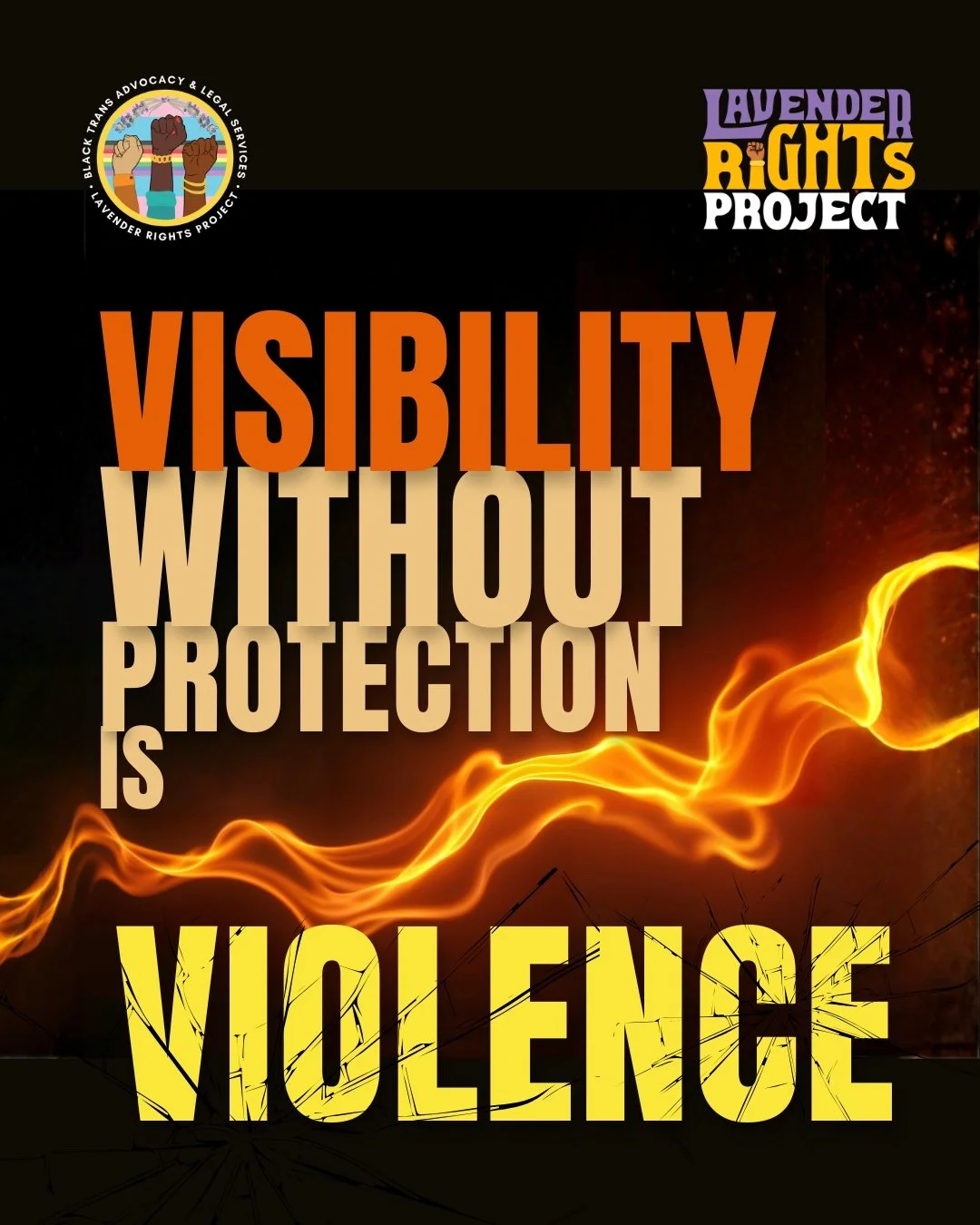
Visibility Without Protection is Violence
Transgender Day of Visibility arrives in a moment where visibility is both a celebration and a battleground.
At Lavender Rights Project, we are clear: visibility has never just been about being seen. It is about being safe. It is about being resourced. It is about being able to exist without negotiation.
Because right now, the narratives about trans people are not just inaccurate—they are dangerous.
Across the country, we are witnessing a coordinated effort to distort who trans people are. Trans people are being framed as threats instead of neighbors. As problems instead of people. As political talking points instead of whole human beings with histories, families, and futures.
These narratives are not accidental. They are strategic.
They are designed to create fear.
They are designed to justify harm.
They are designed to make the public comfortable with policies that strip away access to healthcare, housing, education, and basic dignity.
And we know this pattern.
We have seen it before.
The same playbook used to criminalize Black communities.
The same rhetoric used to roll back reproductive rights.
The same fear-based storytelling that turns marginalized people into scapegoats for broader systemic failures.
What is happening to trans people right now is not happening in isolation. It is part of a broader attack on bodily autonomy, on truth, and on who gets to belong.
That is why Trans Day of Visibility matters more than ever.
But we have to be honest about what visibility means.
Visibility without protection is exposure.
Visibility without resources is abandonment.
Visibility without truth is propaganda.
At Lavender Rights Project, we are not interested in surface-level visibility. We are committed to true and honest visibility—the kind that tells the full story.
That means naming that trans people are leaders, caregivers, artists, and organizers.
That means honoring Black trans women and femmes who have always been at the forefront of movement work.
That means recognizing that trans people are building systems of care where institutions have failed.
It also means telling the truth about what trans people are navigating right now:
Rising violence.
Targeted legislation.
Barriers to housing and healthcare.
And a media landscape that too often amplifies harm instead of humanity.
True visibility interrupts all of that.
It replaces fear with understanding.
It replaces misinformation with lived experience.
It shifts the narrative from “debate” to dignity.
And most importantly—it reminds us that liberation is not a siloed project.
At Lavender Rights Project, we believe that our liberation is linked.
When trans people are safe, communities are safer.
When trans people have housing, we are closer to housing justice for all.
When trans people have access to care, we expand what care can look like for everyone.
Because the question is not just “Do we see trans people?”
The question is:
Do we value trans lives enough to tell the truth about them?
Do we build systems that allow them to thrive?
Do we challenge the narratives that put them at risk?
Trans Day of Visibility is an invitation.
An invitation to move beyond symbolism.
An invitation to confront misinformation.
An invitation to stand on the side of truth, care, and collective freedom.
At Lavender Rights Project, we are building toward a future where visibility is no longer about survival—but about possibility.
Where trans people are not just seen, but supported.
Not just acknowledged, but protected.
Not just included, but centered in the world we are building next.
Because a future that is safe for trans people is a future that is safer for all of us.